Victoria’s Anglican bishops stand by truth-telling Royal Commission
This article was first published in The Melbourne Anglican on 2 July 2025.
The Victorian Anglican Church has acknowledged its complicity with government policies that separated Indigenous people and families and led to ingrained hardship as detailed by the Yoorrook Justice Commission in its final report released on 1 July.
Bishops Genieve Blackwell, Matt Brain, Clarence Bester, Garry Weatherill and Richard Treloar reiterated the apologies made to First Peoples throughout the commission in a joint statement.
“Systemic racism and structural disadvantage persist in our communities and our churches,” the bishops said.
They recognised the ongoing trauma of enforced segregation and assimilation that separated First Nations peoples from Country, language, lore and family, and prevented the practice of culture and spirituality.
“The cultural genocide that marked the early period of Victoria’s colonisation has led to inter-generational trauma and ongoing injustice for First Nations people up to the present day,” they said.
The bishops said the dioceses of the province were actively considering the strong recommendations in relation to landholdings as made in the report and several dioceses had already resolved to increase the proceeds from land sales directed to First Nations organisations.
“We will continue to engage with Traditional Owners, State Government, and the emerging Aboriginal and Torres Strait Islander Council of the Anglican Province of Victoria, in working through the Commission’s reports and recommendations,” they said.
—
Earlier
The Church’s complicity in the dispossession of First Peoples has been detailed in the Yoorrook Royal Commission final report, tabled in the Victorian state parliament yesterday.
Truth be told is the first truth-telling report in Australia exposing genocide and crimes against humanity after four years and over 1300 submissions.
Yoorrook noted senior representatives from the Anglican, Catholic and Uniting churches appeared before the commission, not in prayer or sermon, but in accountability.
The report said leaders were publicly confronted with the legacy of their institutions’ entwinement with colonisation.
The colonial government gave funds or land for more than 500 churches across Victoria, the commission heard.
The report said these grants were part of the wider dispossession of First Peoples, including removal from Country and confinement in missions and reserves, many of which were operated by or in partnership with Anglican and Uniting churches.
These actions resulted in the severing of language, the silencing of culture, and the disruption of connection to Country and kin, the report said.
Anglican bishop Richard Treloar testified in 2024 to the commission of the church’s complicity with government policies that caused the dispossession, removal and attempted assimilation of First Nations people.
Dr Treloar said state policies of segregation and assimilation were implemented by the Church of England for decades from the 1850s onwards.
“Cultural genocide, separation from Country and kin with associated generational trauma, and the beginnings of what we would now call Aboriginal deaths in custody, are among the consequences of this so-called ‘protectionist’ practice,” he told the commission.
Commissioner Travis Lovett noted of the churches represented, only the Anglican Church had provided detail on total land value at the time of the public hearing.
Special Counsel Tim Goodwin said the Anglican Church’s property trust held an estimated 260.05 hectares of land in Victoria, amounting to approximately $1.49 billion.
He noted the disparity between the treatment of churches and First Peoples, stating no First Nations Traditional Owner group held land to that value.
The Indigenous-led commission made 100 recommendations to the state parliament, calling for urgent reforms in self-determination, rights and accountability, land, education, health, housing, economic and political life, record access, and redress.
First Peoples’ Assembly co-chair Rueben Berg said Victoria needed a different approach that drew on the expertise of First Peoples to design and deliver practical solutions to local problems.
“Truth and treaty go hand-in-hand,” he said. “Treaty will acknowledge our shared history and be an agreement between First Peoples and the Victorian Government on how we move forward together to help right past wrongs.”
Premier Jacinta Allan thanked the commission for shining a light on hard truths and laying the foundation for a better future for all Victorians.
“Victoria’s truth-telling process is a historic opportunity to hear the stories of our past that have been buried,” she said. “These are stories that all Victorians need to hear.”
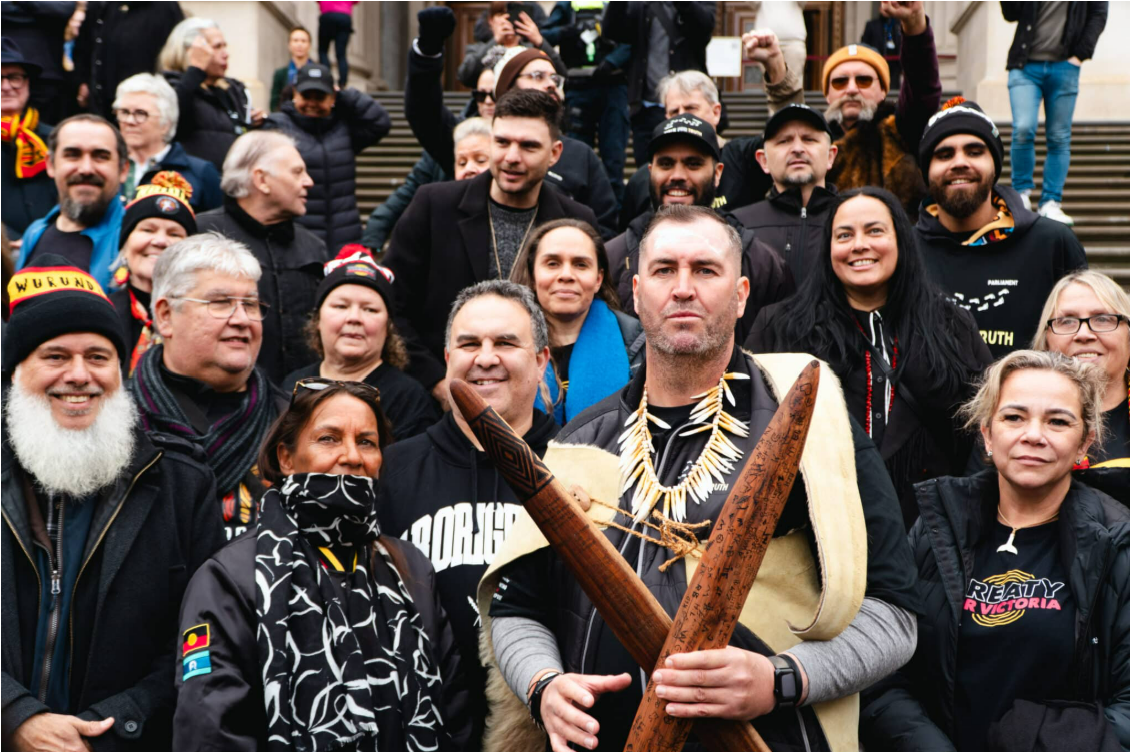
Image: Commissioner and Yoorrook deputy chair Travis Lovett on the steps of Parliament House. Picture: Sybil Gazzard
For communications strategy and services contact Key Change Communications. Follow us on Facebook and LinkedIn.